Showing posts with label what happened on this date in criminal history. Show all posts

Thursday, September 19, 2013

President James A. Garfield died - 1881


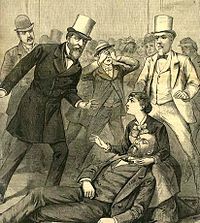
On September 19, 1881, President James A. Garfield succumbs to wounds inflicted by an assassin 80 days earlier. Garfield's assassin was an attorney and political office-seeker named Charles Guiteau. Guiteau was a relative stranger to the president and his administration in an era when federal positions were doled out on a "who you know" basis. When his requests for an appointment were ignored, a furious Guiteau stalked the president, vowing revenge.
On the morning of July 2, 1881, Garfield headed for the Baltimore and Potomac Railroad station on his way to a short vacation. As he walked through the station toward the waiting train, Guiteau stepped behind the president and fired two shots. The first bullet grazed Garfield's arm; the second lodged below his pancreas. Doctors made several unsuccessful attempts to remove the bullet while Garfield lay in his White House bedroom, awake and in pain. Alexander Graham Bell, who was one of Garfield's physicians, tried to use an early version of a metal detector to find the second bullet, but failed. Historical accounts vary as to the exact cause of Garfield's death. Some believe that experimental medical treatments may have hastened his demise. Others insist Garfield died from an already advanced case of heart disease. By early September, Garfield, who was recuperating at a seaside retreat in New Jersey, appeared to be recovering. He died on September 19th. Autopsy reports at the time said that pressure from his internal wound had created an aneurism, which was the likely cause of death. Guiteau was deemed sane by a jury, convicted of murder and hanged on June 30, 1882.
 
Michael Thomas Barry is a columnist for crimemagazine.com and the author of Murder & Mayhem 52 Crimes that Shocked Early California 1849-1949. The book can be purchased from Amazon through the following link:

Wednesday, September 18, 2013

Patty Hearst was captured - 1975


On September 18, 1975, newspaper heiress and wanted fugitive Patty Hearst is captured in a San Francisco apartment and arrested for armed robbery. On February 4, 1974, Patricia Hearst, the 19-year-old daughter of newspaper publisher Randolph Hearst, was kidnapped from her apartment in Berkeley, California. Her fiancé, Stephen Weed, was beaten and tied up along with a neighbor who tried to help. Witnesses reported seeing a struggling Hearst being carried away blindfolded, and she was put in the trunk of a car. Neighbors who came out into the street were forced to take cover after the kidnappers fired their guns to cover their escape.
Three days later, the Symbionese Liberation Army (SLA), a small U.S. leftist group, announced in a letter to a Berkeley radio station that it was holding Hearst as a "prisoner of war." Four days later, the SLA demanded that the Hearst family give $70 in foodstuffs to every needy person from Santa Rosa to Los Angeles. This done, said the SLA, negotiations would begin for the return of Patricia Hearst. Randolph Hearst hesitantly gave away some $2 million worth of food. The SLA then called this inadequate and asked for $4 million more. The Hearst Corporation said it would donate the additional sum if the girl was released unharmed. In April, however, the situation changed dramatically when Patty Hearst declared, in a tape sent to the authorities, that she was joining the SLA of her own free will. Later that month, a surveillance camera took a photo of her participating in an armed robbery of a San Francisco bank, and she was also spotted during the robbery of a Los Angeles store. On May 17th, police raided the SLA's secret headquarters in Los Angeles, killing six of the group's nine known members. Among the dead was the SLA's leader, Donald DeFreeze, an African American ex-convict who called himself General Field Marshal Cinque. Patty Hearst and two other SLA members wanted for the April bank robbery were not on the premises. Finally, on September 18, 1975, after crisscrossing the country for more than a year, Hearst, or "Tania," as she called herself, was captured in a San Francisco apartment and arrested for armed robbery. Despite her later claim that she had been brainwashed by the SLA, she was convicted on March 20, 1976, and sentenced to seven years in prison. Her prison sentence was commuted by President Jimmy Carter and she was released in February 1979. She later married her bodyguard. In 2001, she received a full pardon from President Bill Clinton.

Monday, April 2, 2012

John Gotti Convicted of Murder & Racketeering - 1992

On this date in 1992, a jury in New York finds mobster John Gotti, nicknamed the Teflon Don for his ability to elude conviction, guilty on 13 counts, including murder and racketeering. In the wake of the conviction, the assistant director of the FBI’s New York office, James Fox, was quoted as saying, “The don is covered in Velcro, and every charge stuck.” On June 23 of that year, Gotti was sentenced to life in prison, dealing a significant blow to organized crime.


John Joseph Gotti, Jr., was born in the Bronx, New York, on October 27, 1940. He rose through the ranks of the Gambino crime family and seized power after ordering the December 1985 murder of then-boss Paul Castellano outside a Manhattan steakhouse. Behind closed doors, Gotti was a ruthless, controlling figure. Publicly, he became a tabloid celebrity, famous for his swagger and expensive suits, which earned him another nickname, the Dapper Don.

During the 1980s, Gotti’s lawyer Bruce Cutler won him acquittals three times. A jury member in one of those trials was later convicted of accepting a bribe to acquit the mob boss. In December 1990, Gotti was arrested at the Ravenite Social Club, his headquarters in New York City's Little Italy neighborhood. The ensuing trial, which started in January 1992, created a media frenzy. Salvatore “Sammy the Bull” Gravano, one of Gotti’s top soldiers, made a deal with the government and testified in court against his boss. Gravano admitted to committing 19 murders, 10 of them sanctioned by Gotti. In addition, prosecutors presented secret taped conversations that incriminated Gotti. After deliberating for 13 hours, the jury, which had been kept anonymous and sequestered during the trial, came back with a verdict on April 2, 1992, finding Gotti guilty on all counts. The mob boss was sent to the U.S. Penitentiary at Marion, Illinois, where he was held in virtual solitary confinement. On June 10, 2002, Gotti died of throat cancer at age 61 at a Springfield, Missouri, medical center for federal prisoners.

Sunday, April 1, 2012

Marvin Gaye Shot and Killed - 1984

On this date in 1984, Marvin Gaye was shot and killed by his father.


He was the Prince of Motown, the soulful voice behind hits as wide-ranging as "How Sweet It Is (To Be Loved By You)" and "Mercy Mercy Me (The Ecology)." Like his label-mate Stevie Wonder, Gaye both epitomized and outgrew the crowd-pleasing sound that made Motown famous. Over the course of his roughly 25-year recording career, he moved successfully from upbeat pop to "message" music to satin-sheet soul, combining elements of Smokey Robinson, Bob Dylan and Barry White into one complicated and sometimes contradictory package. But as the critic Michael Eric Dyson put it, the man who "chased away the demons of millions...with his heavenly sound and divine art" was chased by demons of his own throughout his life.

If the physical cause of Marvin Gaye's death was straightforward—"Gunshot wound to chest perforating heart, lung and liver," according to the Los Angeles County Coroner—the events that led to it were much more tangled. On the one hand, there was the longstanding conflict with his father dating back to childhood. Marvin Gay, Sr., (the "e" was added by his son for his stage name) was a preacher in the Hebrew Pentecostal Church and a proponent of a strict moral code he enforced brutally with his four children. He was also, by all accounts, a hard-drinking cross-dresser who personally embodied a rather complicated model of morality. By some reports, Marvin Sr. harbored significant envy over his son's tremendous success, and Marvin Jr. clearly harbored unresolved feelings toward his abusive father.

Those feelings spilled out for the final time in the Los Angeles home of Marvin Gay, Sr., and his wife Alberta. Their son the international recording star had moved into his parents' home in late 1983 at a low point in his struggle with depression, debt and cocaine abuse. Only one year removed from his first Grammy win and from a triumphant return to the pop charts with "Sexual Healing," Marvin Gaye was in horrible physical, psychological and financial shape, and now he found himself living in the same house as the man who must have been at the root of many of his struggles.

After an argument between father and son escalated into a physical fight on the morning of April 1, 1984, Alberta Gay was trying to calm her son in his bedroom when Marvin Sr. took a revolver given to him by Marvin Jr. and shot him three times in his chest. Marvin Gaye's brother, Frankie, who lived next door, and who held the legendary singer during his final minutes, later wrote in his memoir that Marvin Gaye's final, disturbing statement was, "I got what I wanted....I couldn't do it myself, so I made him do it."

Saturday, March 31, 2012

Elephant Butte New Mexico Murders - 1999

On this date in 1999, law enforcement officers in Elephant Butte, New Mexico, began digging for evidence near the mobile home of David Parker Ray and Cynthia Lea Hendy after more evidence came to light about the couple's activities. On March 22, a twenty-two year old woman was found running naked, except for a padlocked metal collar around her neck, down an unpaved road near Elephant Butte State Park. She told police that Ray and Hendy had abducted her three days earlier in Albuquerque before bringing her to the mobile home where she was raped and tortured.

As police delved deeper into Ray and Hendy's background they became convinced that the woman was not the only victim. Upon hearing initial news reports, another woman called New Mexico police with her own tale of sexual torture at the hands of the couple. Then, an acquaintance of Hendy told investigators that she had previously spoken about Ray burying people near their home.

The woman escaped when Ray was at his job at the State Park. She got into a scuffle with Hendy and hit her on the back of the head with an ice pick. Hendy pled guilty to being an accomplice and then even more was revealed. Soon David Ray's daughter Jesse was also charged for her participation in a similar 1996 attack. And the Ray's friend Dennis Yancy was charged with the murder of a young woman who disappeared from in 1997 from an Elephant Butte bar.

Friday, March 30, 2012

President Ronald Reagan Shot - 1981

On March 30, 1981, President Ronald Reagan is shot in the chest outside the Washington Hilton, hotel by a deranged drifter named John Hinckley Jr.


The president had just finished addressing a labor meeting at the Washington Hilton Hotel and was walking with his entourage to his limousine when Hinckley, standing among a group of reporters, fired six shots at the president, hitting Reagan and three of his attendants. White House Press Secretary James Brady was shot in the head and critically wounded, Secret Service agent Timothy McCarthy was shot in the side, and District of Columbia policeman Thomas Delahaney was shot in the neck. After firing the shots, Hinckley was overpowered and pinned against a wall, and President Reagan, apparently unaware that he'd been shot, was shoved into his limousine by a Secret Service agent and rushed to the hospital.

The president was shot in the left lung, and the .22 caliber bullet just missed his heart. In an impressive feat for a 70-year-old man with a collapsed lung, he walked into George Washington University Hospital under his own power. As he was treated and prepared for surgery, he was in good spirits and quipped to his wife, Nancy, ''Honey, I forgot to duck,'' and to his surgeons, "Please tell me you're Republicans." Reagan's surgery lasted two hours, and he was listed in stable and good condition afterward.

The next day, the president resumed some of his executive duties and signed a piece of legislation from his hospital bed. On April 11, he returned to the White House. Reagan's popularity soared after the assassination attempt, and at the end of April he was given a hero's welcome by Congress. In August, this same Congress passed his controversial economic program, with several Democrats breaking ranks to back Reagan's plan. By this time, Reagan claimed to be fully recovered from the assassination attempt. In private, however, he would continue to feel the effects of the nearly fatal gunshot wound for years.

Of the victims of the assassination attempt, Secret Service agent Timothy McCarthy and D.C. policeman Thomas Delahaney eventually recovered. James Brady, who nearly died after being shot in the eye, suffered permanent brain damage. He later became an advocate of gun control, and in 1993 Congress passed the "Brady Bill," which established a five-day waiting period and background checks for prospective gun buyers. President Bill Clinton signed the bill into law.

After being arrested on March 30, 1981, 25-year-old John Hinckley was booked on federal charges of attempting to assassinate the president. He had previously been arrested in Tennessee on weapons charges. In June 1982, he was found not guilty by reason of insanity. In the trial, Hinckley's defense attorneys argued that their client was ill with narcissistic personality disorder, citing medical evidence, and had a pathological obsession with the 1976 film Taxi Driver, in which the main character attempts to assassinate a fictional senator. His lawyers claimed that Hinckley saw the movie more than a dozen times, was obsessed with the lead actress, Jodie Foster, and had attempted to reenact the events of the film in his own life. Thus the movie, not Hinckley, they argued, was the actual planning force behind the events that occurred on March 30, 1981.

The verdict of "not guilty by reason of insanity" aroused widespread public criticism, and many were shocked that a would-be presidential assassin could avoid been held accountable for his crime. However, because of his obvious threat to society, he was placed in St. Elizabeth's Hospital, a mental institution. In the late 1990s, Hinckley's attorney began arguing that his mental illness was in remission and thus had a right to return to a normal life. Beginning in August 1999, he was allowed supervised day trips off the hospital grounds and later was allowed to visit his parents once a week unsupervised. The Secret Service voluntarily monitors him during these outings. If his mental illness remains in remission, he may one day be released.

Thursday, March 29, 2012

The Mad Bomber Strikes New York City's Grand Central Station - 1951

On this day in 1951, a homemade device explodes at Grand Central Station in New York City, startling commuters but injuring no one. In the next few months, five more bombs were found at landmark sites around New York, including the public library. Authorities realized that this new wave of terrorist acts was the work of the Mad Bomber.

New York's first experience with the so-called Mad Bomber was on November 16, 1940, when a pipe bomb was left in the Edison building with a note that read, "Con Edison crooks, this is for you." More bombs were recovered in 1941, each more powerful than the last, until the Mad Bomber sent a note in December stating, "I will make no more bomb units for the duration of the war." He went on to say that Con Edison, New York's electric utility company, would be brought to justice in due time.
The patriotic Mad Bomber made good on his promise, although he did periodically send threatening notes to the press. After his flurry of activity in 1951, the Mad Bomber was silent until a bomb went off at Radio City Music Hall in 1954. In 1955, the Mad Bomber hit Grand Central Station, Macy's, the RCA building and the Staten Island Ferry.


The police had no luck finding the Mad Bomber, but an investigative team working for Con Ed finally tracked him down. Looking through their employment records, they found that George Peter Metesky had been a disgruntled ex-employee since an accident in 1931. Metesky was enraged that Con Ed refused to pay disability benefits and resorted to terrorism as his revenge. Metesky, a rather mild-mannered man, was found living with his sisters in Connecticut. He was sent to a mental institution in April 1957 where he stayed until his release in 1973.

Tuesday, March 27, 2012

The First British murder case to be solved using fingerprints - 1905

 On this date in 1905, Thomas and Ann Farrow, shopkeepers in South London, are discovered bludgeoned in their home. Thomas was already dead, but Ann was still breathing. She died four days later without ever having regained consciousness. The brutal crime was solved using the newly developed fingerprinting technique. Only three years earlier, the first English court had admitted fingerprint evidence in a petty theft case. The Farrow case was the first time that the cutting-edge technology was used in a high-profile murder case. 


Since the cash box in which the Farrow's stored their cash receipts was empty, it was clear to Scotland Yard investigators that robbery was the motive for the crime. One print on the box did not match the victims or any of the still-tiny file of criminal prints that Scotland Yard possessed. Fortunately, a local milkman reported seeing two young men in the vicinity of the Farrow house on the day of the murders. Soon identified as brothers Alfred and Albert Stratton, the police began interviewing their friends.

Alfred's girlfriend told police that he had given away his coat the day and changed the color of his shoes the day after the murders. A week later, authorities finally caught up with the Stratton brothers and fingerprinted them. Alfred's right thumb was a perfect match for the print on the Farrow's cash box.

The fingerprint evidence became the prosecution's only solid evidence when the milkman was unable to positively identify the Stratton’s. The defense put up expert Dr. John Garson to attack the reliability of the fingerprint evidence. But the prosecution countered with evidence that Garson had written to both the defense and prosecution on the same day offering his services to both. The Stratton brothers, obviously not helped by the discrediting of Garson, were convicted and hanged on May 23, 1905. Since then, fingerprint evidence has become commonplace in criminal trials and the lack of it is even used by defense attorneys.

Monday, March 26, 2012

Heaven's Gate Cult Members Found Dead - 1997

More commonly known as "Hale-Bopper's" and not technically a crime (but it should have been ). No one was ever charged with a crime in association with the mass suicide.


On March 26, 1997, following an anonymous tip, police enter a mansion in Rancho Santa Fe, an exclusive suburb of San Diego, California, and discover 39 victims of a mass suicide. The deceased, 21 women and 18 men of varying ages were all found lying peaceably in matching dark clothes and Nike sneakers and had no noticeable signs of blood or trauma. It was later revealed that the men and women were members of the "Heaven's Gate" religious cult, whose leaders preached that suicide would allow them to leave their bodily "containers" and enter an alien spacecraft hidden behind the Hale-Bopp comet.


The cult was led by Marshall Applewhite, a music professor who, after surviving a near-death experience in 1972, was recruited into the cult by one of his nurses, Bonnie Lu Nettles. In 1975, Applewhite and Nettles persuaded a group of 20 people from Oregon to abandon their families and possessions and move to eastern Colorado, where they promised that an extraterrestrial spacecraft would take them to the "kingdom of heaven." Nettles, who called herself "Ti," and Applewhite, who took the name of "Do," explained that human bodies were merely containers that could be abandoned in favor of a higher physical existence. As the spacecraft never arrived, membership in Heaven's Gate diminished, and in 1985 Bonnie Lu Nettles, Applewhite's "sexless partner," died. 

During the early 1990s, the cult resurfaced as Applewhite began recruiting new members. Soon after the 1995 discovery of the comet Hale-Bopp, the Heaven's Gate members became convinced that an alien spacecraft was on its way to earth, hidden from human detection behind the comet. In October 1996, Applewhite rented a large home in Rancho Santa Fe, explaining to the owner that his group was made up of Christian-based angels. Applewhite advocated sexual abstinence, and several male cult members followed his example by undergoing castration operations. 

In 1997, as part of its 4,000-year orbit of the sun, the comet Hale-Bopp passed near Earth in one of the most impressive astronomical events of the 20th century. In late March 1997, as Hale-Bopp reached its closest distance to Earth, Applewhite and 38 of his followers drank a lethal mixture of phenobarbital and vodka and then lay down to die, hoping to leave their bodily containers, enter the alien spacecraft, and pass through Heaven's Gate into a higher existence.

Sunday, March 25, 2012

Assassination of King Faisal of Saudi Arabia - 1975


On this date in 1975, King Faisal of Saudi Arabia was shot to death by his nephew, Prince Faisal.

King Faisal, son of King Ibn Saud, fought in the military campaigns in the 1920s and '30s that helped forge modern Saudi Arabia. He later served as Saudi ambassador to the United Nations and in 1953 was made premier upon the ascension of his older brother, Saud. In 1964, King Saud was pressured to abdicate, and Faisal became the absolute ruler of Saudi Arabia. As king, he sought to modernize his nation, and lent financial and moral support to anti-Israeli efforts in the Middle East. In 1975, Faisal was assassinated for reasons that remain obscure, and his son, Crown Prince Khalid, ascended to the throne.

Saturday, March 24, 2012

Jonesboro Arkansas School Shooting - 1998

Mitchell Johnson, 13, and Andrew Golden, 11, shoot their classmates and teachers in Jonesboro, Arkansas. Golden, the younger of the two boys, asked to be excused from his class, pulled a fire alarm and then ran to join Johnson in a wooded area 100 yards away from the school's gym. As the students streamed out of the building, Johnson and Golden opened fire and killed four students and a teacher. Ten other children were wounded.

The two boys were caught soon afterward. In their possession were thirteen fully loaded firearms, including three semi-automatic rifles, and 200 rounds of ammunition. Their stolen van had a stockpile of supplies as well as a crossbow and several hunting knives. All of the weapons were taken from the Golden family's personal arsenal. Both of the boys had been raised around guns. They belonged to gun clubs and even participated in practical shooting competitions, which involve firing at simulated moving human targets. Golden reportedly shot several dogs in preparation for the actual shooting.


Because Johnson and Golden were thirteen and eleven, they could not be charged as adults in Arkansas. They were both adjudicated as delinquent and sent to reform institutes. They were to be released when they turned eighteen, as they could legally no longer be housed with minors, but Arkansas bought a facility in 1999 that enabled the state to keep the boys in custody until their twenty-first birthdays. Johnson was freed in 2005; Golden was released in 2007. Neither has any criminal record. Arkansas changed its laws following the Jonesboro tragedy so that child murderers can be imprisoned past twenty-one.

School shootings were highly publicized in the media during the late 1990s who ascribed the supposed epidemic to violent movies, television and video games. However, violence against students in school actually went down significantly in the late 1990s, throwing into the question the entire theory.

Friday, March 23, 2012

Luis Donaldo Colosio Mexican Presidential Candidate is Assassinated - 194

On this date in 1994, Luis Donaldo Colosio, Mexico’s ruling party's presidential candidate, is gunned down during a campaign rally in the northern border town of Tijuana.


As a member of the Institutional Revolutionary Party (PRI), the political party that held power in Mexico for most of the 20th century, Colosio became the protĂťgĂť of future Mexican president Carlos Salinas de Gortari and was elected to the Congress and Senate. In 1988, he was the campaign manager of Salinas' successful presidential campaign and the same year was named PRI party head. In 1992, President Salinas appointed Colosio social development secretary. He became increasingly reform-minded in this capacity; although his promises to reduce Mexico's widespread poverty failed to stop anti-government guerrilla activity in the state of Chiapas. Salinas designated Colosio his successor in late 1993, making him the PRI candidate and thus the favorite to win the presidential election scheduled for August 1994. Colosio campaigned as a man of the people and often appeared without the protection of bodyguards.  

On March 23, 1994, he was assassinated at a campaign rally in Tijuana. Mario Aburto Martinez, a factory worker, was arrested at the scene and later convicted as the sole shooter. During the next few years, however, evidence was uncovered suggesting a conspiracy that may have led all the way up to President Salinas' office. Colosio had promised to fight Mexico's rampant political corruption, of which Salinas, who had ties to organized crime in Mexico, was guilty. I

In the wake of the assassination, Salinas appointed Ernesto Zedillo the PRI presidential campaign. Zedillo was elected in an election unusually free from fraud, and served as Mexican president until 2000. Salinas spent the late 1990s in exile but returned to Mexico in 2000. His administration has been implicated in other political assassinations, and in 1999 his brother Raul was convicted of ordering and financing the September 1994 murder of Jose Francisco Ruiz Massieu, the secretary general of the PRI.

Thursday, March 22, 2012

McMartin Pre-school Molestation indictments - 1984

On this date in 1984, seven teachers at the McMartin Preschool in Manhattan Beach, California are indicted by the Los Angeles County grand jury after hearing testimony from 18 children. Included among the charged are Peggy McMartin Buckey, the head of the school and her son Ray Buckey, after seven years and millions of dollars, the case against the teachers came to a close with no reputable evidence of wrongdoing and no convictions. 


The McMartin school debacle began on August 12, 1983 when Judy Johnson reported to the police that she believed her 2-1/2-year-old son had been molested at the McMartin Preschool. The first major blunder occurred less than a month into the investigation. On September 8, the Manhattan Beach Police Department sent out a form letter to more than 200 families, alerting them of an investigation into the allegations of child molestation and naming Ray Buckey as a suspect. The latter set off a wave of hysteria in the community and compounding the problem, virtually every child who attended the school was sent to the Children's Institute International, an organization that claimed it could get children to reveal abuse even when they didn't want to talk about it. Unfortunately, CII was also capable of getting easily manipulated children to reveal abuse when it had never actually happened. 

The allegations that CII produced grew more bizarre every day. They reported that they had been taken to a cemetery where dead bodies were dug and hacked to pieces (causing blood to spurt out). The local Catholic Church invited an expert on Satanic cults to talk to the congregation in the wake of the allegations. Of course, there wasn't any corroboration of these wild allegations from any witnesses although the school often had visitors and guests. The truth or falsity of the allegations mattered little to the community at large. The McMartin School was burned down in an arson attack and seven other local preschools closed down as people who worked with children began to fear that they would be the next accused. Unfortunately for other child care workers around the nation, the abuse scare of the early 1990s found many victims. More recent research has demonstrated that questioning techniques of children can easily be manipulated so that the child will give the answer that the questioner desires.

Wednesday, March 21, 2012

Alcatraz Prison Closes - 1963

On this date in 1963, Alcatraz Prison in San Francisco Bay closes down and transfers its last prisoners.


At it's peak period of use in 1950s, "The Rock, or ""America's Devil Island" housed over 200 inmates at the maximum-security facility. Alcatraz remains an icon of American prisons for its harsh conditions and record for being inescapable. The twelve-acre rocky island, one and a half miles from San Francisco, featured the most advanced security of the time. Some of the first metal detectors were used at Alcatraz. Strict rules were enforced against the unfortunate inmates who had to do time at Alcatraz. Nearly complete silence was mandated at all times.

Alcatraz was first explored by Juan Manuel de Ayala in 1775, who called it Isla de los Alcatraces (Pelicans) because of all the birds that lived there. It was sold in 1849 to the U.S. government. The first lighthouse in California was on Alcatraz. It became a Civil War fort and then a military prison in 1907. The end of its prison days did not end the Alcatraz saga. In March 1964, a group of Sioux claimed that the island belonged to them due to a 100-year-old treaty. Their claims were ignored until November 1969 when a group of eighty-nine Native Americans representing the American Indian Movement (AIM) occupied the island. They stayed there until 1971 when AIM was finally forced off the island by federal authorities. The following year, Alcatraz was added to the Golden Gate National Recreation Area. It is now open for tourism.

Sunday, March 18, 2012

The Yosemite Murders - 1999

On this day in 1999, the bodies of Carole Sund and Silvina Pelosso are found in a charred rental car in a remote wooded area of Long Barn, Califonia. The women, along with Sund's daughter Juli, had been missing since February when they were last seen alive at the Cedar Lodge near Yosemite National Park. Juli Sund's body was found thirty miles away a week after the car was found. The mysterious disappearance of the three women had drawn national attention and landed them on the cover of People magazine. Compounding the mystery, Carole Sund's wallet had been found on a street in downtown Modesto, California, three days after they had disappeared. Police and the FBI initially focused their investigation on Eugene Dykes, Michael Larwick, and a group of methamphetamine users in Northern California. However, all these leads went up in smoke in July when Joie Ruth Armstrong, a twenty-six-year-old Yosemite Park worker, was brutally killed and decapitated near her cabin in the park.

The discovery of her body led investigators to Cary Stayner, a thirty-seven-year-old man who worked at the Cedar Lodge motel, where the Sunds were last seen. Stayner was tracked down and caught at a nudist colony in Northern California. Stayner confessed to the murder of Armstrong and then surprised the detectives by admitting that he was also responsible for the murders of the Sunds and Pelosso. Stayner had been on the other end of another high-profile crime years earlier. His younger brother, Steven, was abducted in Merced when Cary was eleven years old. Steven Stayner was held for more than seven years by a sexual abuser, Kenneth Parnell. Following his escape, a television movie, I Know My First Name is Steven, dramatized the incident. Steven Stayner died in a tragic motorcycle accident when he was twenty-four. The family saw further tragedy when Jesse Stayner, Cary and Steven's uncle, was shot to death in 1990 during a bungled robbery attempt. Stayner pled guilty to the Armstrong murder in 2001. He was convicted of the other three counts of murder in 2002 and sentenced to death.

Saturday, March 17, 2012

Raymond Clark III pleads guilty to the murder of Annie Le - 2011

On this day in 2011, 26-year-old Raymond Clark III, a former animal research assistant at Yale University in New Haven, Connecticut, pleads guilty to the murder and attempted sexual assault of 24-year-old Yale graduate student Annie Le. On September 13, 2009, Le’s partially decomposed body was found stuffed behind a wall in the university research building where she was last seen five days earlier.

Le, a doctoral student in pharmacology from Placerville, California, was found dead on the day she was scheduled to be married, prompting initial speculation after her September 8, 2009, disappearance that could be a runaway bride. However, that theory soon appeared to be largely ruled out by investigators. Surveillance video showed Le entering the Yale lab building, which was accessible only by electronic keycard, but never leaving it. Her money, cell phone and ID were found in her office, located in a separate building.

Le’s disappearance set off a massive investigation that included more than 100 officers from university, state and local police and the FBI. The case also garnered national media attention. A break came on September 12, when investigators found bloody clothing above ceiling tiles in the lab building. The following day, Le’s body was discovered behind a wall in the building’s basement. It was determined the 4-foot-11-inch, 90-pound Le had been strangled.

Middletown, Connecticut, resident Raymond Clark, who cared for the animals in the lab where Le worked, soon sparked the suspicions of police after he was observed scrubbing the seemingly clean floor in the room where Le was last seen. On September 17, police arrested Clark, after finding DNA and other evidence they said linked him to the crime. Among the evidence was a bloody sock with both Clark’s and Le’s DNA on it, as well as a pen found under Le’s body with Clark’s DNA. Additionally, investigators discovered scratches on Clark’s body (which he claimed were from a cat), and found keycard records placing him and Le in the same room in the lab building on the day she was reported missing.

In January 2010, Clark pleaded not guilty to murder. However, on March 17 of the following year, after negotiations between the prosecutor in the case and Clark’s lawyers, the former lab technician pleaded guilty to charges of murder and attempt to commit sexual assault, in order to avoid a trial. He did not specify a motive, and the reason for his actions remains unclear. On June 3, 2011, Clark was sentenced to 44 years in prison without the possibility of early release.

Friday, March 16, 2012

The Jilted Lover Murder, Judge Roy Bean dies, Terry Anderson is kidnapped, & Robert Blake is aquitted of murder

The Jilted Lover Murder - 1881


Francisco "Chico" Forster is shot to death on downtown Los Angeles street by his jilted lover, eighteen-year old Lastania Abarta. The forty-year old Forster was the son of wealthy Los Angeles land developer and considered one of the city's most eligible bachelors despite his reputation for womanizing and poorly treating women. Abarta worked in her parent's pool hall, where she sang, played the guitar, and met frequent customer Forster. On March 14, she was invited to perform at a party given by Pio Pico, California’s last Mexican governor. The former politician had just lost a sizable tract of land near San Diego to Chico Forster's father. During a song, Abarta changed the lyrics to mock Pico and then ran off with Forster to the Moiso Mansion Hotel. 

Apparently, the couple made love after Forster promised to marry Abarta. But when Forster disappeared and didn't return with a ring or priest to perform the ceremony, Abarta and her sister Hortensia started to comb the city in search of him. They finally found him at a race track gambling and dragged him to their carriage for a trip to the church. But Forster got out of the cab on the way, the women closely following behind until Abarta suddenly pulled out a gun and shot him through the eye. Outraged by his son's untimely death, Forster's father hired a special prosecutor to make sure that Abarta was properly punished. 

Abarta's lawyers tried a novel defense, they ran with America's 1880s obsession with "female hysteria." Medical theories of the time held that women could be driven crazy because of their reproductive system. Their first step was to introduce in evidence the blood stained sheets from the hotel where Abarta lost her virginity to Forster. The lawyers then trotted out no less than seven medical experts who expounded their hysteria theories. They testified that Abarta was clearly displaying classic "hysterical symptoms" caused "because her brain was undoubtedly congested with blood," when she killed Forster.

However, the most important testimony came from Dr. Joseph Kurtz who received applause from the spectators in the courtroom when he stated that "Any virtuous woman when deprived of her virtue would go mad, undoubtedly." The jury, all men of course, took just twenty minutes to acquit Abarta, who left town and disappeared out of sight.

Judge Roy Bean Dies - 1903


Roy Bean, the self-proclaimed "law west of the Pecos," dies in Langtry, Texas. A saloonkeeper and adventurer, Bean's claim to fame rested on the often humorous and sometimes-bizarre rulings he meted out as a justice of the peace in western Texas during the late 19th century. By then, Bean was in his 50s and had already lived a life full of rough adventures. Born in Kentucky some time during the 1820s, Bean began getting into trouble at an early age. He left home in 1847 with his brother Sam and lived a rogue's life in Mexico until he shot a man in a barroom fight and had to flee. He next turned up in San Diego, where he enjoyed playing the dashing caballero. Again he shot a man during a quarrel and was forced to leave town quickly. He fell into the same old habits in Los Angeles, eventually killing a Mexican officer in a duel over a woman. Angry friends of the officer hanged Bean in revenge, but luckily, the rope stretched and Bean managed to stay alive until the woman he had fought for arrived to cut him down. Bearing rope scars on his neck that remained throughout his life, Bean left California to take up a less risky life in New Mexico and Texas. For about 16 years, Bean lived a prosperous and relatively legitimate life as a San Antonio businessman. In 1882, he moved to southwest Texas, where he built his famous saloon, the Jersey Lilly, and founded the hamlet of Langtry. Saloon and town alike were named for the famous English actress, Lillie Langtry. Bean had never met Langtry, but he had developed an abiding affection for the beautiful actress after seeing a drawing of her in an illustrated magazine. For the rest of his life, he avidly followed Langtry's career in theatre magazines. Before founding Langtry, Bean had also secured an appointment as a justice of the peace and notary public. He knew little about the law or proper court procedures, but residents appreciated and largely accepted his common sense verdicts in the sparsely populated country of West Texas. Bean was often deliberately humorous or bizarre in his rulings, once fining a dead man $40 for carrying a concealed weapon. He threatened one lawyer with hanging for using profane language when the hapless man referred to the "habeas corpus" of his client. Less amusing was Bean's decision to free a man accused of killing a Chinese rail worker on the grounds that Bean knew of no law making it a crime "to kill a Chinaman."

By the 1890s, reports of Bean's curmudgeonly rulings had made him nationally famous. Travelers on the train passing through Langtry often made a point of stopping to visit the ramshackle saloon, where a sign proudly proclaimed Bean to be the "Law West of the Pecos." Bean fell ill during a visit to San Antonio. He returned to Langtry, where he died on March 16, 1903. Lillie Langtry, the object of Bean's devoted adoration, visited the village named in her honor only 10 months after Bean died. 

Journalist Terry Anderson is kidnapped - 1985

In Beirut, Lebanon, Islamic militants kidnap American journalist Terry Anderson and take him to the southern suburbs of the war-torn city, where other Western hostages are being held in scattered dungeons under ruined buildings. Before his abduction, Anderson covered the Lebanese Civil War for The Associated Press (AP) and also served as the AP's Beirut bureau chief. On December 4, 1991, Anderson's Hezbollah captors finally released him after 2,455 days. He was the last and longest-held American hostage in Lebanon. Although his seven-year ordeal was the longest of the 92 foreigners abducted during Lebanon's civil war, he was saved the fate of 11 hostages who died or were believed murdered. Anderson spent his entire captivity blindfolded and was released when the 16-year civil war came to an end. In 1993, Anderson published Den of Lions, a memoir of his time in captivity. In 2002, he won a lawsuit against the Iranian government and was granted a multi-million dollar settlement. The next year, Anderson ran for the Ohio Senate as a Democrat, but was defeated. 

Actor Robert Blake is acquitted of his wife’s murder - 2005


On this day in 2005, after a three-month-long criminal trial in Los Angeles Superior Court, a jury acquits Robert Blake, star of the 1970s television detective show Baretta, of the murder of his 44-year-old wife, Bonny Lee Bakley. Blake, who was born Mickey Gubitosi in 1933 in New Jersey, made his movie debut at the age of six, in MGM’s 1939 movie Bridal Suite; the studio soon featured him in its Our Gang series of short films. After changing his name to Robert Blake, he starred in the 1960 gangster movie The Purple Gang and numerous other films. In 1967, Blake memorably portrayed Perry Smith, one of two real-life murderers at the center of Truman Capote’s In Cold Blood, when the book was adapted for the big screen. As an actor, Blake was best known for his Emmy-winning work as the street-smart plainclothes policeman Tony Baretta in the ABC series Baretta. The show ran from 1975 to 1978, and Blake won an Emmy Award for Best Actor in a Drama Series at the end of its first season. During his criminal trial, Blake’s defense team portrayed the aging actor as a rather pathetic figure and argued that Bakley had a pattern of sending letters and nude photos of herself to famous men and had trapped Blake into marrying her by becoming pregnant. The couple’s daughter, Rose, was born in June 2000, and though Bakley initially claimed that the child was fathered by Christian Brando, son of the celebrated actor Marlon Brando, a paternity test proved the baby was Blake’s. Blake and Bakley married that November. Their brief, unhappy union lasted until May 4, 2001, when Bakley was shot to death as she sat in a car outside a Los Angeles restaurant. 


Blake was arrested for the murder, and the prosecution produced two former stunt doubles who claimed the actor had recruited them to kill his wife. During cross-examination, the stuntmen were revealed to be cocaine and methamphetamine users. In their acquittal of Blake, the jury made it clear they didn’t believe the stuntmen’s statements, and also concluded that the prosecution had failed to place the murder weapon in Blake’s hands. In November 2005, eight months after the criminal trial ended, Robert Blake was found guilty in a civil trial of “intentionally” causing Bonny Lee Bakley’s death; he was ordered to pay $30 million to Bakley’s children. Rose remained in the care of Blake’s eldest daughter, Delinah. Though he did not testify in the criminal trial, Blake did take the stand during his civil trial to deny the accusations.

Thursday, March 15, 2012

Ides of March 44 BC - Julius Caesar is murdered


Julius Caesar, the "dictator for life" of the Roman Empire, is murdered by his own senators at a meeting in a hall next to Pompey's Theatre. The conspiracy against Caesar encompassed as many as sixty noblemen, including Caesar's own protege, Marcus Brutus. Caesar was scheduled to leave Rome to fight in a war on March 18 and had appointed loyal members of his army to rule the Empire in his absence. The Republican senators, already chafing at having to abide by Caesar's decrees, were particularly angry about the prospect of taking orders from Caesar's underlings. Cassius Longinus started the plot against the dictator, quickly getting his brother-in-law Marcus Brutus to join.
Caesar should have been well aware that many of the senators hated him, but he dismissed his security force not long before his assassination. Reportedly, Caesar was handed a warning note as he entered the senate meeting that day but did not read it. After he entered the hall, Caesar was surrounded by senators holding daggers. Servilius Casca struck the first blow, hitting Caesar in the neck and drawing blood. The other senators all joined in, stabbing him repeatedly about the head.

Marcus Brutus wounded Caesar in the groin and Caesar is said to have remarked in Greek, "You, too, my child?" In the aftermath of the assassination, Antony attempted to carry out Caesar's legacy. However, Caesar's will left Octavian in charge as his adopted son. Cassius and Brutus tried to rally a Republican army and Brutus even issued coins celebrating the assassination, known as the Ides of March. Octavian vowed revenge against the assassins, two years later Cassius and Brutus committed suicide after learning that Octavian's forces had defeated theirs at the Battle of Philippa in Greece.
Antony took his armies east, where he hooked up with Caesar's old paramour, Cleopatra. Octavian and Antony fought for many years until Octavian prevailed. In 30 B.C., Antony committed suicide. Octavian, later known as Augustus, ruled the Roman Empire for many more years.

Wednesday, March 14, 2012

FBI's 10 Most Wanted List debuts - 1950


On this day in 1950, the Federal Bureau of Investigation institutes the "Ten Most Wanted Fugitives" list in an effort to publicize particularly dangerous fugitives. The creation of the program arose out of a wire service news story in 1949 about the "toughest guys" the FBI wanted to capture. The story drew so much public attention that the "Ten Most Wanted" list was given the okay by J. Edgar Hoover the following year. As of 2011, 465 of the criminals included on the list have been apprehended or located, 153 as a result of tips from the public. The Criminal Investigative Division (CID) of the FBI asks all fifty-six field offices to submit candidates for inclusion on the list. The CID in association with the Office of Public and Congressional Affairs then proposes finalists for approval of by the FBI's Deputy Director. The criteria for selection is simple, the criminal must have a lengthy record and current pending charges that make him or her particularly dangerous. And the the FBI must believe that the publicity attendant to placement on the list will assist in the apprehension of the fugitive.
Generally, the only way to get off the list is to die or to be captured. There have only been a handful of cases where a fugitive has been removed from the list because they no longer were a particularly dangerous menace to society. Only eight women have appeared on the Ten Most Wanted list. Ruth Eisemann-Schier was the first in 1968. The FBI also works closely with the Fox television show America's Most Wanted to further publicize the effort to capture dangerous felons.

Sunday, March 11, 2012

COPS TV show airs for the first time in 1989


On this day in 1989, COPS, a documentary-style television series that follows police officers and sheriff's deputies as they go about their jobs, debuts on Fox. COPS went on to become one of the longest-running shows in television history. The show, which was created by John Langley and Malcolm Barbour, was a pioneer in reality television. Crews with camcorders followed law enforcement officers on patrol, tracking down suspects and making arrests. The show was unscripted, which worked in Langley and Barbour's favor when they pitched the original concept to Fox: At the time, there was a writers' strike in Hollywood, and the network needed new programming that wouldn't require writers. In 1989, the debut episode of COPS featured the men and women of the Broward County Sheriff's Department in Florida. The show has aired nearly 1,000 episodes and filmed in 140 U.S. cities, as well as international locations including London and Hong Kong. With its widely recognized theme song, "Bad Boys" by the reggae group Inner Circle, COPS had spawned numerous imitators in addition to parody shows